
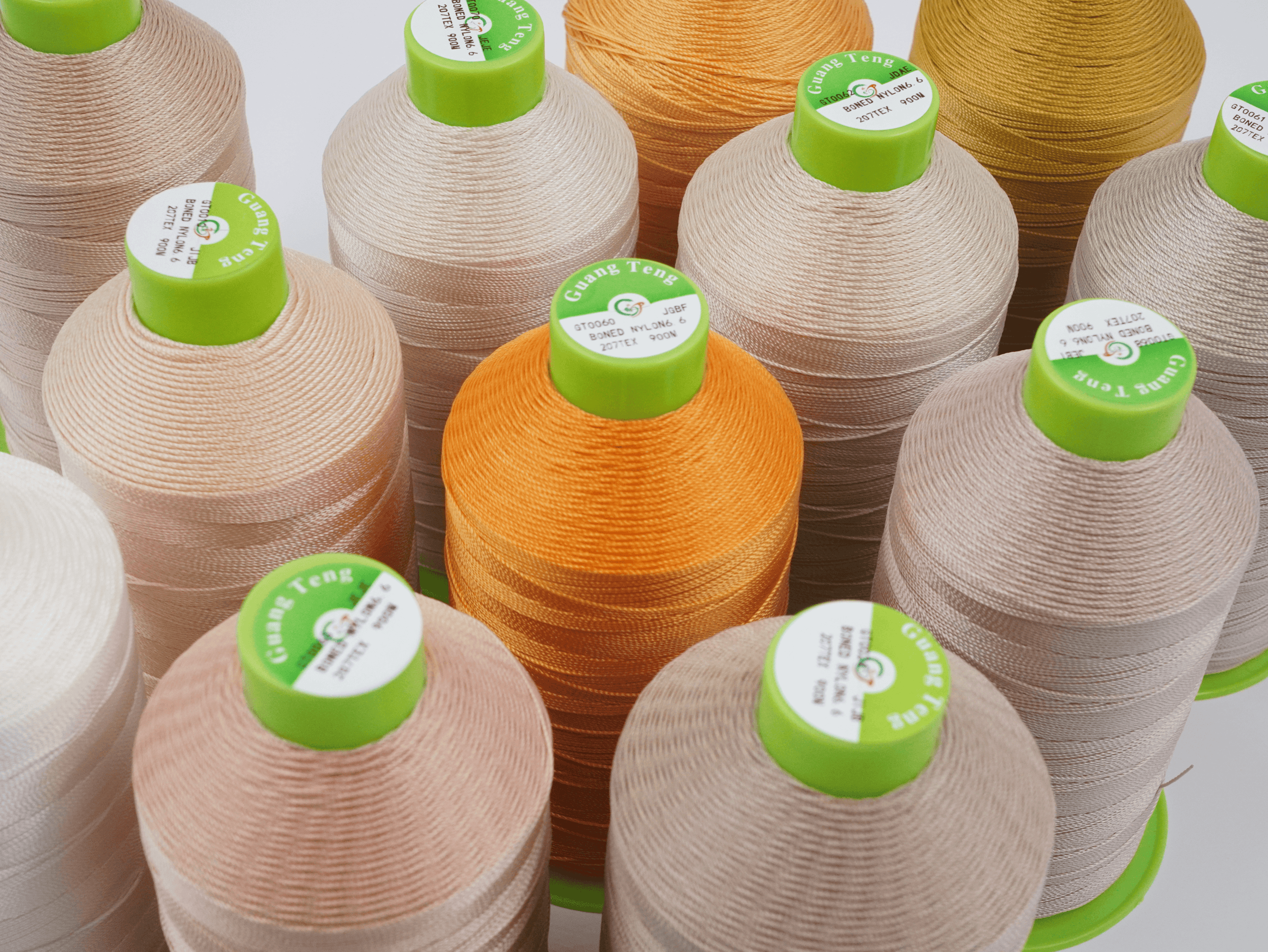
Part I: Application Scenarios and Key Requirements for Heavy-Duty Sewing
When sewing heavy leather, thick canvas, saddlery components, tool bags, and other substantial assemblies, thread size needs to be matched carefully with the material, seam design, needle, and sewing machine. Tex 210 (commercial Size 207 / V207) is a large bonded nylon thread intended for applications where a heavier stitch profile and greater thread size are appropriate.
NEXUS Tex 210 bonded nylon is made from Polyamide 6.6 and is positioned for heavy sewing applications that can accommodate a larger thread diameter. Its suitability depends on the complete sewing system, including the material, stitch construction, needle size, machine clearance, feeding system, and operating conditions. It should not be interpreted as a military, life-safety, climbing, fall-arrest, or other certified safety thread unless a specific certification is provided for that application.
⚠️ Machine Setup Considerations for Tex 210 Thread
Because Tex 210 is a relatively large sewing thread, machine setup becomes more important. Needle size, upper and bobbin tension, hook clearance, feeding system, material thickness, and stitch construction can all affect sewing performance. An unsuitable setup may contribute to problems such as excessive friction, skipped stitches, needle deflection, or inconsistent stitch formation. Machine compatibility should therefore be confirmed before production use.
Part II: Internal Test Data and Product Reference Specifications
NEXUS maintains internal tensile test records for Tex 210 (#207) Bonded Nylon 6.6 Thread. The values below reflect the tested sample and the stated test conditions. They are provided as product reference data and should not be interpreted as independent laboratory certification, compliance with a military or life-safety standard, or a permanent performance guarantee for every production batch, seam or finished product.
| Technical Parameter | Internal Test / Product Reference Data |
|---|---|
| Material Composition | Polyamide 6.6 Continuous Filament |
| Thread Construction / Finish | Bonded Treatment — Helps Keep Plied Strands Together |
| Suggested Needle Range | Nm 140/22 to Nm 180/24 |
| Mean Breaking Strength — Tested Sample | 14,539.46 cN |
| Maximum Breaking Strength — Tested Sample | 14,908.91 cN |
| Tensile Tenacity | 7.69 g/D |
| Mean Elongation at Break | 27.77% |
| Breaking Strength C.V. | 1.96% |
| Elongation C.V. | 4.38% |
| Internal Test Speed & Gauge Length | 250 mm/min / 400 mm |
| Recorded Test Environment | 25°C / 60% RH |
Part 3: Application and Use Considerations
Because Tex 210 (#207) is a relatively large thread size, application and machine compatibility should be reviewed carefully before use. Material thickness, seam design, needle size, hook clearance, feeding system and machine capability can all affect sewing performance.
Heavy Leather and Substantial Sewing Applications
- Recommended Applications: Typical applications may include heavy leather goods, saddlery components, thick tool bags, substantial belts, heavy footwear and other projects where a larger stitch profile is desired. Suitability still depends on the material, seam design, machine setup and intended use.
Canvas and Heavy Sewn Assemblies
- Approved applications: Tex 210 may also be considered for selected heavy canvas and other substantial sewn assemblies when the material, seam design and sewing equipment can accommodate the thread size. For outdoor use, the fiber material and expected UV exposure should be evaluated separately rather than assuming that thread size alone determines environmental suitability.
⚠️ Considerations for Lightweight Materials
Tex 207 thread is highly destructive to lightweight leather garments, high-end wallets, and lightweight upholstery fabrics (under 8 oz). Its substantial thickness and the required bobbin tension cause the fibers to tear during stitching and lead to severe stretching and deformation of lightweight components.
Production Adjustment Recommendation: For lighter or medium-weight materials, a smaller thread such as Tex 135 or Tex 90 may be more appropriate depending on the application and desired stitch appearance. Final selection should be based on the actual material, seam requirement and machine capability rather than treated as a mandatory size change.
🛠️ Machine Compatibility and Setup Considerations
Many household and light-duty sewing machines may not be designed to handle a thread as large as Tex 210 (#207). Machine compatibility depends on factors such as hook clearance, needle capacity, feeding system, bobbin size, presser-foot lift and the manufacturer’s supported thread range.
Industrial compound-feed or walking-foot machines are often considered for heavier thread and material combinations, but machine class alone does not guarantee compatibility. Before production use, confirm that the selected machine can accommodate the required thread and needle size and test the setup with the actual material and stitch configuration.
Internal Tensile Test Data and Performance Boundaries
NEXUS maintains internal tensile test data for Tex 210 (#207) Bonded Nylon 6.6 Thread. These results describe the tested sample under the stated test conditions and are provided as product reference data. They should not be interpreted as compliance with a military, climbing, fall-arrest, parachute or other life-safety standard unless a specific certification is available for that application.
In the recorded internal tensile test set, the tested Tex 210 sample showed a mean breaking strength of 14,539.46 cN and a maximum recorded breaking strength of 14,908.91 cN. These figures apply to the tested sample and test conditions only and should not be treated as a permanent specification for every production batch or as a load rating for a finished product.
⚡ Elongation at Break — Tested Sample
The tested sample recorded a mean elongation at break of 27.77% under the stated tensile-test conditions. This value describes elongation behavior in that specific test and should not be interpreted as a certified dynamic-impact, energy-absorption or life-safety performance rating.
What size needle should be used for Tex 210 thread?
A larger industrial needle is generally required for Tex 210 (#207) thread. NEXUS product guidance lists Nm 140/22 to Nm 180/24 as a reference range, but final needle selection should be confirmed against the machine, material, stitch requirement and needle system.
Using a needle that is too small for the thread can increase friction at the needle eye and interfere with thread feeding. This may contribute to thread damage, heat buildup, inconsistent tension or sewing instability. Needle-to-thread compatibility should therefore be checked during machine setup rather than relying on thread size alone.
What machine factors should be considered when using Tex 210 thread?
Diagnostic Response: Many domestic and light-duty sewing machines may not be designed to handle a thread as large as Tex 210 (#207). Machine compatibility depends on factors such as hook clearance, needle capacity, feeding system, bobbin size, presser-foot lift and the manufacturer’s supported thread range.
For heavier leather, canvas and other substantial sewn assemblies, industrial machines with appropriate clearance and feeding capability are often more suitable. Class 3 or Class 4 machines may be considered where their specifications support the required thread and needle size, but machine class alone should not be treated as a guarantee of compatibility.
Machine Compatibility Checks:
- Needle Compatibility Limits: NEXUS product guidance lists Nm 140/22 to Nm 180/24 as a reference range for Tex 210 (#207). Final needle selection should be confirmed against the specific machine, material, stitch requirement and needle system. If the needle eye or machine clearance is too small for the thread, friction and feeding problems may increase.
- Class 3 sewing machine :Depending on the model, Class 3 industrial machines may be suitable for medium-to-heavy leather, canvas and tool-bag applications where the machine provides adequate hook clearance, needle capacity, presser-foot lift and feeding capability. Compatibility should be checked against the specific machine model and material combination.
- Class 4 sewing machine : Some Class 4 industrial machines are designed for heavier materials and larger thread sizes and may be considered when Tex 210 is used on substantial leather or canvas assemblies. Their larger hook, bobbin capacity, feeding system and needle range can make them more suitable for demanding sewing setups, but suitability still depends on the specific machine model, material and stitch requirement.
Final Review: Tex 135 vs Tex 210 leather stitching comparison
Selecting between Tex 135 and Tex 210 depends on the material, desired stitch appearance, seam construction and sewing equipment. The comparison below is intended as a selection reference rather than a universal rule for every application. The following is a final selection guide based on quantitative laboratory stress data:
💡 Scenario 1: When Tex 135 May Be the Better Fit
Tex 135 may be more appropriate when the project requires a substantial stitch but does not need the larger profile of Tex 210. Common examples can include leather footwear, luggage, bags, upholstery and other medium-to-heavy sewn products.:
- Traditional Leather Goods and Footwear: Leather footwear, boots, luggage, travel bags and other medium-to-heavy leather products.
- Knife Accessories and Pet Gear: Knife sheaths, leather holsters, dog collars, leashes and similar leather products.
NEXUS maintains internal tensile test data for Tex 135 Bonded Nylon 6.6 Thread. In the tested sample, the recorded mean breaking strength was 10,869.60 cN under the stated test conditions. This value is provided as product reference data and should not be interpreted as a safety margin, finished-seam load rating, equipment-performance guarantee or permanent specification for every production batch.For standard heavy-duty projects requiring consistent, high-volume output, purchasing spools of Tex 135 bonded nylon thread is the recommended choice.
Tex 135 may be a suitable option where a substantial stitch is required but the larger profile of Tex 210 is unnecessary. Final selection should still be based on the material, seam design, machine capability and desired stitch appearance.
🔴 Scenario 2: When Tex 210 May Be the Better Fit
If your finished products fall into categories such as specialized military-grade machinery, life-safety equipment, or heavy-duty components subject to extreme dynamic stresses—for example:
- Tex 210 may be considered when the project requires a larger stitch profile, thicker materials or a heavier thread size and the sewing equipment can accommodate it. Typical examples may include heavy leather goods, saddlery components, thick tool bags, substantial belts, heavy footwear and selected heavy canvas assemblies.
- NEXUS internal tensile test data for Tex 210 can be used as product reference data for the tested sample under the stated conditions. These values should not be interpreted as military, life-safety, load-bearing or finished-product certification.
- Heavy Leatherwork: Multi-layer leather goods, saddlery components, thick tool bags, substantial belts and other heavy leather assemblies.
Internal Test Reference: NEXUS maintains internal tensile test data for Tex 210 Bonded Nylon 6.6 Thread. In the tested sample, the recorded mean breaking strength was 14,539.46 cN and the mean elongation at break was 27.77% under the stated test conditions. These values are provided as product reference data only and should not be interpreted as a safety rating, dynamic-impact rating, load-bearing certification or finished-product performance guarantee.
Compared with Tex 135, Tex 210 provides a larger thread profile and may be more appropriate where a visibly heavier stitch or larger thread size is required. Final selection should still be based on the material, seam design, machine capability and intended use.
