
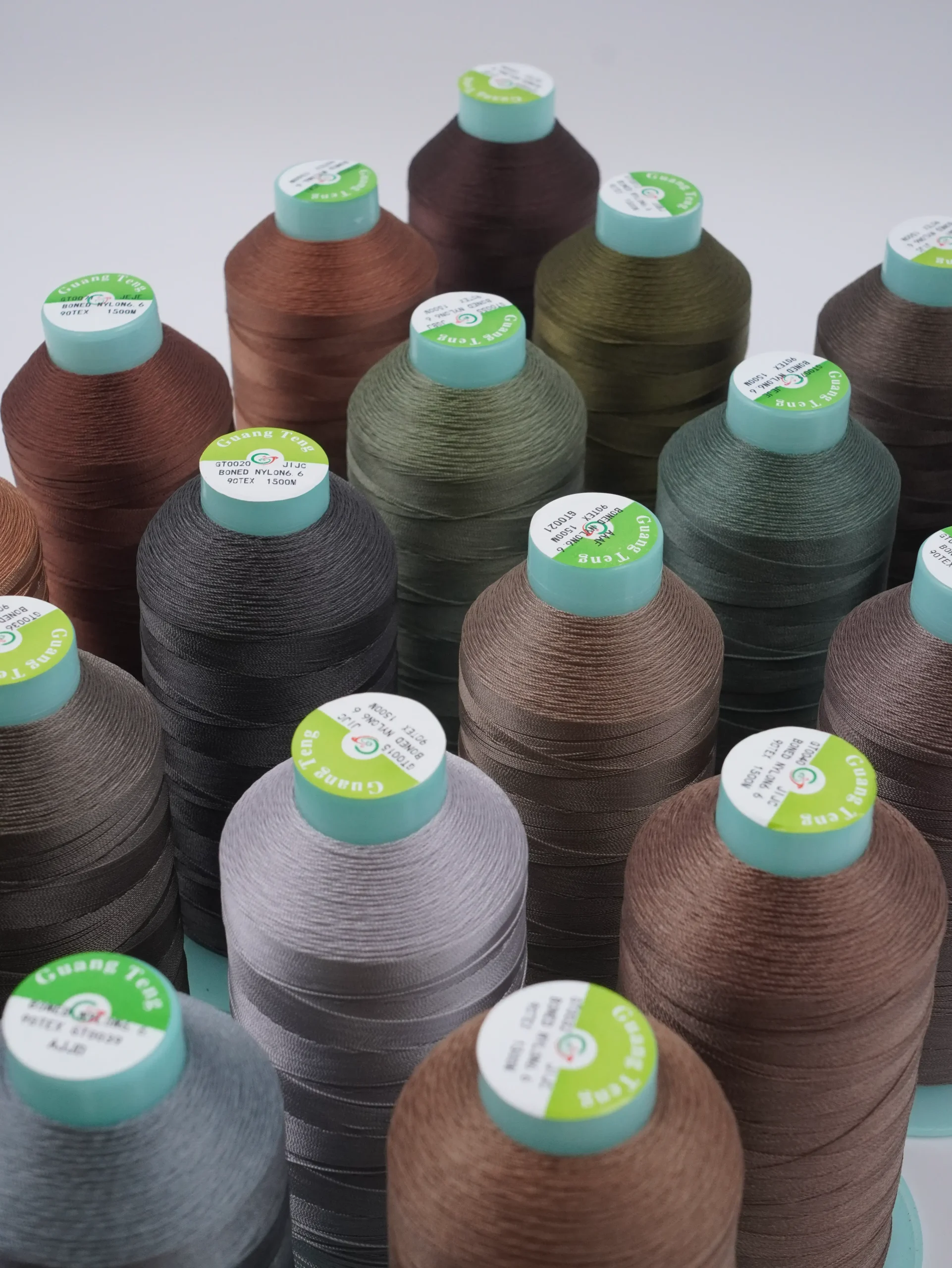
Part 1: Application Scenarios and Core Advantages
Tex 90 (#92) bonded nylon thread is commonly considered for applications that require a medium thread profile, including leather goods, footwear, bags, upholstery and selected canvas projects. Suitability depends on the material, seam design, desired stitch appearance and sewing setup.
Compared with smaller thread sizes such as Tex 70, Tex 90 provides a larger thread profile and more visible stitch appearance. It may be appropriate where the material and sewing equipment can accommodate the thread size and where a stronger visual stitch is preferred. Final selection should be based on the actual application rather than on thread size alone.
🛠️ Key Product Characteristics
- Bonded Construction: The bonded structure helps keep the plied strands together and reduce strand separation during sewing. Actual sewing performance depends on the material, needle, machine setup and operating conditions.
- Polyamide 6.6 Material: NEXUS Tex 90 bonded nylon thread uses Polyamide 6.6 continuous filament. Material behavior such as flexibility, elongation and abrasion performance depends on the thread construction and application conditions.
- Medium Thread Profile: Tex 90 sits between smaller and larger bonded nylon thread sizes and may be suitable for leather goods, footwear, bags, upholstery and selected canvas applications where a medium thread profile is preferred.
Before shipment, NEXUS can provide photos of the actual prepared products for customer review. This helps confirm the prepared product and color, but it should not be treated as a 100% color-match guarantee because photography, lighting and screen settings can affect perceived color.
International shipping times vary by destination, shipment weight, selected service and carrier. Any transit time provided for a specific order should be treated as an estimate rather than a universal delivery guarantee. NEXUS can also support product-selection and application-related questions based on the information provided.
Part 2: The Engineering Specification Grid
| Technical Parameter | Internal Test / Product Reference Data |
|---|---|
| Material Composition | Polyamide 6.6 Continuous Filament |
| Thread Construction | 280D/3 (3 plies) |
| Physical Diameter | Only retain if confirmed by current product records |
| Internal Test Speed / Gauge Length | 250 mm/min / 400 mm |
| Recorded Test Environment | 25°C / 60% RH |
| Mean Breaking Strength — Tested Sample | 6,222.22 cN |
| Tensile Tenacity — Tested Sample | 7.41 g/D |
| Mean Elongation at Break | 25.59% |
| Suggested Needle Range | Nm 110/18 to Nm 125/20 |
| Breaking Strength C.V. | 0.48% |
🔬 These values reflect the tested sample and recorded test conditions. They should not be interpreted as independent laboratory certification, a permanent specification for every production batch, or a finished-product performance guarantee.
Part 3: Application and Use Considerations
Because Tex 90 is a medium thread size, application and machine compatibility should be reviewed according to the material, seam design, needle, machine clearance and desired stitch appearance. The guidance below is intended as a selection reference rather than a universal operating rule.
✅ Typical Application Areas
- Leather Goods and Footwear: Tex 90 may be suitable for wallets, handbags, shoe uppers, leather covers and other medium-weight leather products where a medium thread profile is appropriate.
- Upholstery and Selected Canvas Applications: Tex 90 may be considered for upholstery, automotive interiors, car seats, sofa components and selected canvas projects. For prolonged UV or marine exposure, fiber material should be evaluated separately rather than assuming that bonded nylon is the preferred option.
- Other Substantial Sewn Products: Tex 90 may also be used for dog collars, tents, awnings and similar sewn products where the material and machine setup are appropriate.
⚠️ Machine and Application Considerations
- Machine Compatibility: Some household and light-duty machines may not be designed for Tex 90. Compatibility depends on hook clearance, needle capacity, feeding system, presser-foot lift and the machine manufacturer’s supported thread range.
- Larger Thread Options: If the project requires a larger stitch profile or heavier thread size, Tex 135 or Tex 210 (#207) may be considered where the material and sewing equipment can accommodate the larger thread.
Part 4: Machine Setup and Sewing Considerations
When introducing Tex 90 bonded nylon thread into a sewing setup, machine compatibility, needle selection, tension, feeding and material behavior should be reviewed together. The following points are practical setup considerations rather than universal machine settings.
🛠️ Key Machine Setup Considerations
- Hook Clearance and Timing: Adequate hook clearance and correct machine timing can support stable stitch formation when using Tex 90. If the thread, needle and hook clearance are poorly matched, sewing problems such as friction, skipped stitches or thread damage may occur.
- Needle Selection and Deflection: Material thickness, needle size, thread size and machine setup can all influence needle deflection. A suitable needle and appropriate machine settings can help support more stable sewing through thicker materials.
- Heat and Friction During Sewing: Higher sewing speeds, friction, thread tension and material resistance can increase heat at the needle and thread interface. Appropriate needle selection, lubrication and tension settings may help manage friction, but actual behavior depends on the complete sewing setup.
📊 Workshop Setup and Production Considerations
When introducing Tex 90 into a production setup, machine capability, needle selection, feeding, tension and material behavior should be reviewed together. The goal is to confirm that the thread, machine and material combination is suitable for the intended sewing application.
- Machine Capability:
Check whether the machine provides suitable hook clearance, needle capacity, feeding capability and presser-foot lift for the selected material and thread size. Household or light-duty machines should not be assumed to be compatible without checking the manufacturer’s supported thread and needle range.
- Internal Test Variation:
The reported breaking-strength C.V. of 0.48% describes variation within the tested sample set only. It should not be interpreted as proof of reduced needle wear, lower downtime or improved production efficiency.
⚙️ Workshop Note:Successful use of Tex 90 depends on the complete sewing setup rather than on thread properties alone. Machine clearance, needle size, tension, feeding and the material being sewn should all be evaluated together before production use.
What are the key specifications of Tex 90 (#92) thread?
Tex 90, commonly referred to as Size 92 or V92, is a bonded nylon thread specification used in industrial sewing. Its key reference characteristics include the thread construction, suggested needle range and other confirmed product specifications.
- Thread Construction:
280D/3 — three plies of Polyamide 6.6 continuous filament. - Suggested Needle Range:
Nm 110/18 to Nm 125/20. - Physical Diameter:
Only retain if confirmed by current product records. - Application Positioning:
Tex 90 provides a medium thread profile between smaller sizes such as Tex 70 and larger sizes such as Tex 135. It may be suitable for leather goods, footwear, bags, upholstery and selected canvas applications where the material and sewing equipment can accommodate the thread size.
🔬 Internal Tensile Test Results
NEXUS maintains internal tensile test records for Tex 90 (#92) Bonded Nylon 6.6 Thread. The values below reflect the tested sample and the stated test conditions. They are provided as product reference data and should not be interpreted as independent laboratory certification, a permanent specification for every production batch, or a finished-product performance guarantee.
Mean Breaking Strength — Tested Sample: 6,222.22 cN
Minimum Breaking Strength — Tested Sample: 6,184.45 cN
Maximum Breaking Strength — Tested Sample: 6,263.21 cN
Mean Elongation at Break — Tested Sample: 25.59%
Recorded Elongation Range in the Test Set: 25.04%–26.02%
Breaking Strength C.V.: 0.48%
Elongation C.V.: 1.55%
📐 Test Interpretation:The reported C.V. values describe variation within the tested sample set only. They should not be interpreted as proof of reduced production downtime, fewer line breaks, improved machine uptime, or guaranteed consistency across all future production batches.
What Is the Difference Between Tex 70 and Tex 90?
Tex 70 and Tex 90 differ mainly in thread size, stitch appearance and the sewing setup they typically require. Tex 90 is larger than Tex 70, so changing between the two may require adjustments to needle size, tension and machine setup depending on the material and application.
- Tex 70 (#69):
- 210D/3
- Mean Breaking Strength — Tested Sample: 5,124.23 cN
- Mean Elongation at Break — Tested Sample: 23.47%
- Tex 90 (#92):
- 280D/3
- Mean Breaking Strength — Tested Sample: 6,222.22 cN
- Mean Elongation at Break — Tested Sample: 25.59%
Tex 90 may be more appropriate when a larger stitch profile or heavier thread size is desired. For prolonged UV or marine exposure, fiber material should be evaluated separately rather than selecting between Tex 70 and Tex 90 based on thread size alone.
What Is the Difference Between Tex 90 and Tex 135?
Tex 90 and Tex 135 differ mainly in thread size, stitch appearance and the sewing setup they typically require. Tex 135 is larger than Tex 90 and may be considered where a more substantial stitch profile is desired and the material and machine can accommodate the larger thread size.
Final selection should depend on the material, seam design, machine capability and desired stitch appearance rather than on a fixed leather-weight limit or a universal “upgrade” rule.
What needle size should be considered for Tex 90 thread?
NEXUS product guidance lists industrial needle sizes 110/18 to 125/20 as a reference range for Tex 90 (#92) thread. Final needle selection should be confirmed against the specific sewing machine, material, stitch requirement and needle system.
Using a needle that is too small for the thread can increase friction at the needle eye and interfere with thread feeding. This may contribute to thread damage, inconsistent tension, heat buildup or sewing instability.
Why is my sewing machine needle breaking on heavy canvas?
Needle breakage can result from several factors, including needle size, material thickness, thread-to-needle compatibility, machine timing, needle deflection, thread tension and overall machine setup.
When using Tex 90 on heavier materials, an undersized or unsuitable needle may increase friction or deflection and contribute to sewing problems. Use the product needle guidance as a starting point, then confirm the final setup with the actual machine, material and stitch configuration.
