Bonded nylon thread can develop visible surface fuzzing during sewing due to friction around the needle eye, needle-to-thread mismatch, hook interaction, material thickness, or thread lubrication conditions.
However, fraying does not automatically mean the thread is defective. Surface fuzzing, ply separation, thread breakage, and skipped stitches are different problems that require different checks.
Based on NEXUS production knowledge and practical sewing experience, this guide explains how to identify these symptoms, investigate possible contributing factors, and determine when physical thread testing is necessary.
1. First, Identify the Sewing Thread Problem
Before changing the needle, adjusting tension, or replacing the thread, identify the actual sewing problem.
Several different symptoms are often described as thread fraying, but they should not be treated as the same issue.
| Symptom | What You May See | What It Does Not Automatically Prove |
|---|---|---|
| Surface fuzzing | Small fibers protruding from the thread or finished stitches | Defective thread or bonding failure |
| Ply separation | Individual strands of a multi-ply thread begin separating | The exact cause of bonding instability |
| Thread breakage | The thread breaks during sewing | Insufficient tensile strength |
| Skipped stitches or jamming | Missing stitches or interrupted thread movement | A thread material defect |
Surface Fuzzing or Fraying
Surface fuzzing appears as small fibers on the thread or finished stitches. The thread may look slightly hairy or rough while its overall multi-ply structure remains intact.
Possible contributing factors include friction at the needle eye, hook interaction, material thickness, and lubrication conditions.
Light surface fuzzing does not necessarily lead directly to thread breakage.
Ply Separation or Unraveling
Ply separation occurs when the individual strands forming a multi-ply thread begin to separate.
Unlike ordinary surface fuzzing, this involves the cohesion of the thread structure itself.
Bonding helps hold the plies together, but material type, bonding quality, twist, and downstream processing can influence the final result.
Thread Breakage
Thread breakage means the sewing thread actually breaks during operation.
It may occur alongside visible surface damage, but the presence of fuzzing alone does not establish why the thread broke.
Skipped Stitches and Thread Jamming
Skipped stitches involve incomplete stitch formation, while thread jamming interrupts normal thread movement.
Both require evaluation of the complete sewing system rather than an automatic assumption of defective thread.
Real Sewing Example: Tex90 Bonded Nylon Thread
The following photographs show visible thread fuzzing during double-needle sewing with NEXUS Tex90 (280D/3) Bonded Nylon 6.6 Thread.
The photographs provide a real sewing reference for identifying the visible symptom.
They do not, by themselves, establish whether the observed condition resulted from bonding quality, needle friction, hook interaction, or other sewing conditions.
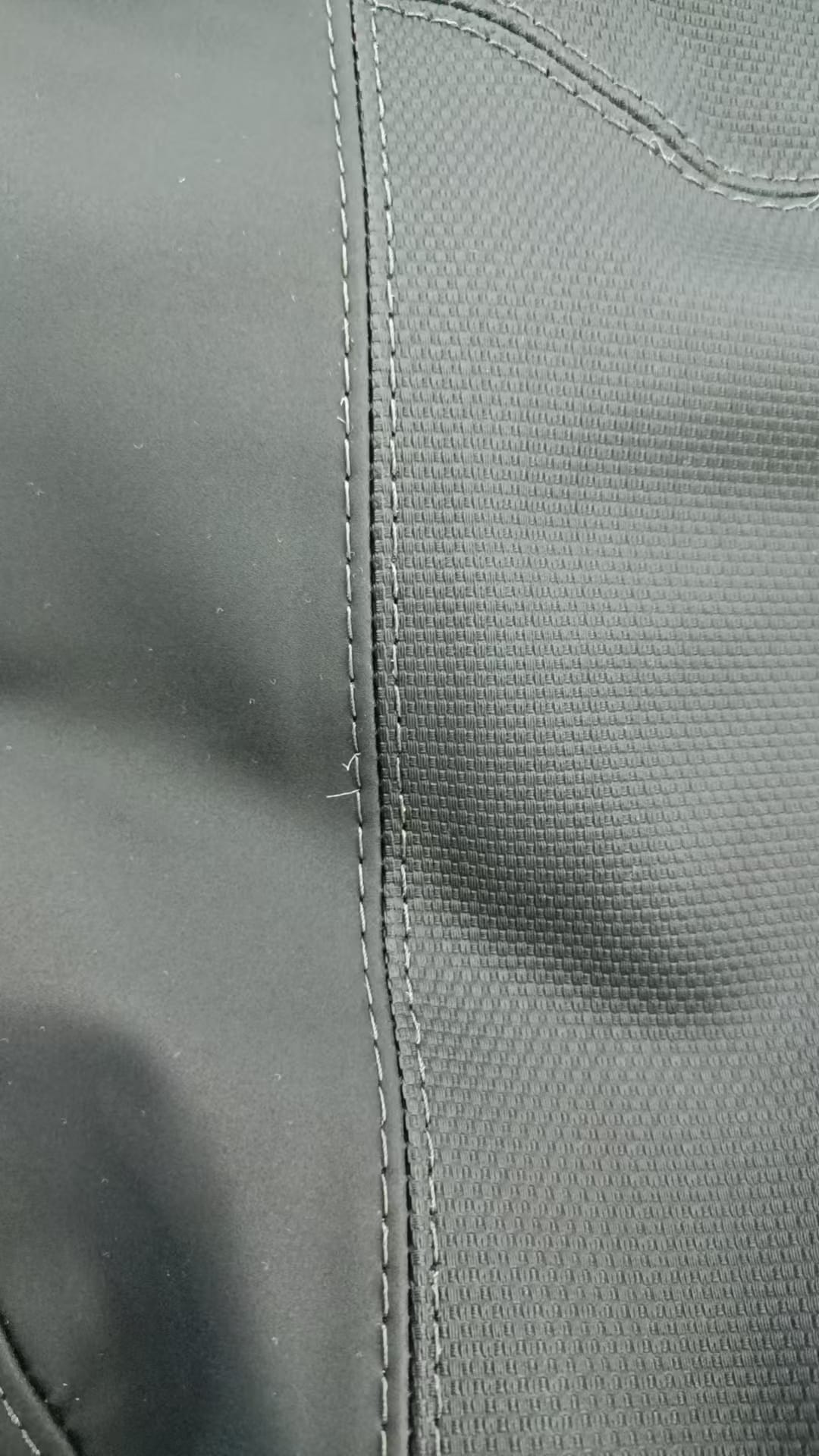
Figure 1. Actual Tex90 double-needle sewing example showing visible fibers along the stitched seam.

Figure 2. A closer view highlighting the areas where thread irregularities were observed. The markings identify areas of concern, not a confirmed cause of bonding failure.
2. What Can Cause Bonded Nylon Thread to Fuzz During Sewing?
Surface fuzzing can have several contributing factors.
The following factors are based on NEXUS production and customer experience. They are possible causes to investigate, not a universal diagnosis for every sewing machine or thread.
Needle Size and Needle-Eye Friction
The relationship between needle size and thread diameter is an important consideration.
If the needle is too small for the selected thread, the thread may experience increased friction as it repeatedly passes through the needle eye.
This can contribute to surface damage during sewing.
For example, a sewing setup that accommodates a smaller thread may not be appropriate when switching to a larger Tex size.
A change in thread size should therefore be accompanied by a review of needle compatibility.
The correct combination depends on the thread specification, needle system, sewing machine, and material being sewn.
Troubleshooting consideration: Confirm that the selected needle is suitable for the thread size and sewing application. Do not assume that increasing the needle size alone will resolve the problem.
Hook, Thread Path, and Machine Interaction
Thread movement involves more than the needle.
During sewing, the thread interacts with the machine’s threading path and stitch-forming components, including the hook mechanism.
Based on NEXUS practical customer experience, unsuitable or unstable hook interaction may contribute to thread damage and sewing problems.
For this reason, it is useful to consider whether fuzzing appears under particular machine conditions or continues across different sewing setups.
However, the presence of fuzzing does not prove that the hook requires adjustment.
Machine-specific hook position, clearance, timing, and other mechanical settings should be evaluated according to the actual machine and its manufacturer’s guidance.
Troubleshooting consideration: Review the complete thread path and stitch-forming interaction rather than changing one machine setting without identifying the problem.
Material Thickness and Sewing Speed
The sewn material also influences thread behavior.
Sewing through thick or dense material can place additional demands on the needle, thread, and sewing machine.
In NEXUS practical experience, friction-related issues can become more noticeable during continuous high-speed sewing.
This does not mean that high-speed sewing will always damage bonded nylon thread.
Instead, sewing speed should be considered together with needle compatibility, material thickness, thread size, and machine setup.
When a problem appears only under particular production conditions, those conditions are important information for diagnosis.
Troubleshooting consideration: Record the material being sewn and the operating conditions under which fuzzing becomes visible.
Lubrication and Thread Surface Condition
Thread lubrication is another factor worth investigating.
Lubrication and finishing processes are used to improve thread smoothness and handling during sewing.
During the production process for NEXUS bonded thread, finishing and lubrication treatments are applied at designated processing stages to support smoother thread movement and handling.
These process steps do not establish a fixed oil-content percentage or coefficient-of-friction value for the finished thread. Project-specific testing is required when such quantified properties are requested.
Based on practical experience, insufficient lubrication may contribute to increased friction and surface fuzzing.
However, NEXUS does not currently publish a fixed, quantified oil-content percentage or coefficient-of-friction value for its finished bonded sewing thread.
These properties require project-specific verification when a customer needs a defined technical value.
Troubleshooting consideration: If abnormal surface friction is suspected, include the thread’s surface condition and lubrication in the technical review. Do not infer a particular oil-content percentage from its appearance or feel.
3. Why Can Plies Separate Even in Bonded Thread?
One purpose of bonding is to help maintain the structure of multi-ply sewing thread.
Understanding the bonding process helps explain both its benefits and its limitations.
What Internal Bonding Does
NEXUS Nylon 6.6 bonded thread uses an internal bonding process.
During production, multiple nylon filaments are combined and twisted, with a hot-melt filament positioned between the plies.
During heat setting, the hot-melt filament forms an internal bond that helps hold the thread structure together.
This bonding construction is intended to reduce strand separation and support stable thread handling during sewing.
It does not mean that the thread is guaranteed never to fray, unravel, or break under any operating condition.
The actual sewing result still depends on the complete application.
For a broader explanation, read What Is a Bonded Thread?.
Bonding Quality, Twist, and Downstream Processing
Bonded thread stability is influenced by several production factors, including the material, bonding quality, twist, and subsequent processing.
Twist helps maintain the arrangement of the individual plies. However, more twist is not automatically better: the appropriate twist depends on the thread construction and processing requirements.
NEXUS production experience also recognizes that inappropriate stretching or mechanical damage during processing can affect bonding stability.
These observations are part of practical production knowledge, not a quantified claim that a specific processing condition will always cause ply separation.
There is also an important distinction between material types.
NEXUS has recorded relatively few ply-separation complaints involving nylon bonded thread. Its experience with polyester bonded thread indicates that bonding stability may require particular attention when repeated color reworking or excessive stretching occurs.
These observations should not be generalized into a universal defect rate for either material.
For a particular customer complaint, the physical condition of the actual thread must be examined before identifying bonding quality as the cause.
4. A Practical Troubleshooting Sequence
An effective troubleshooting process should begin with observations rather than assumptions.
The objective is to identify the problem, preserve useful evidence, and determine whether the next step requires physical thread testing or investigation of the sewing setup.
Step 1: Document the Symptom and Sewing Conditions
Before making major changes, record the basic conditions under which the problem occurs.
Useful information includes:
- The thread material and Tex size
- The sewing machine model and needle specification
- The type and thickness of the material being sewn
- Whether the problem is surface fuzzing, ply separation, breakage, or skipped stitches
- Whether the symptom appears immediately or during continuous sewing
- Whether it occurs with a particular thread spool, material, or operating condition
- Clear photographs of the affected thread and finished stitches, where available
This information helps separate observations from assumptions.
For example, visible surface fuzzing does not, by itself, establish whether the cause lies in the thread or the sewing conditions.
Step 2: Check Needle, Thread Path, and Machine Compatibility
For basic troubleshooting, review whether the selected thread and needle are appropriate for the sewing application.
Potential areas for examination include needle-to-thread compatibility, the thread path, hook interaction, and the way the material passes through the machine.
Any inspection or adjustment should follow the sewing machine manufacturer’s safety and maintenance instructions.
A machine that performs normally with one thread size may require a different setup for another thread size.
However, no single needle change, tension adjustment, or hook adjustment should be treated as a guaranteed solution.
If there is a suspected product-quality problem, avoid using repeated machine adjustments as a substitute for checking the actual thread.
Step 3: When Thread Samples Should Be Physically Tested
If the problem persists or a material-related issue is suspected, preserve the affected thread sample or spool and record the available product or batch information.
For a formal product-quality complaint, NEXUS requests the affected thread for physical evaluation against its applicable acceptance requirements.
A visible sewing symptom alone is not sufficient to establish that the thread itself is nonconforming.
5. How NEXUS Evaluates Thread-Related Complaints
NEXUS evaluates reported thread-quality problems by first examining the affected thread against applicable physical acceptance requirements, before reaching conclusions about the sewing machine or application.
Physical Acceptance Checks
NEXUS uses a four-stage quality control process for bonded sewing thread:
- Incoming bonded-yarn inspection before dyeing
- Quality checks after dyeing
- Elongation checks after stretching and setting
- Final inspection after winding and forming
These checks cover relevant physical properties at different stages of production.
For a formal customer complaint, the affected thread is requested for examination using the applicable acceptance requirements.
Separating Material Findings from Machine and Application Factors
If the returned thread does not meet the applicable physical requirements, NEXUS treats it as nonconforming.
If the tested properties meet the applicable requirements, the investigation continues with the actual sewing conditions, including needle compatibility, hook interaction, machine setup, and material characteristics.
Normal physical test results do not automatically explain every sewing problem. They provide evidence about the tested properties and help determine which factors need further investigation.
This approach avoids treating every visible sewing issue as either an automatic thread defect or an automatic machine problem.her than claiming that one machine adjustment will resolve every complaint.
6. Choosing the Right Bonded Thread for Your Sewing Setup
The most suitable sewing thread is not necessarily the thickest or the one with the highest reported breaking force.
A useful selection considers the thread material, size, sewing equipment, application, and finished stitch requirements.
Review Thread Size, Material, and Application
NEXUS supplies Nylon 6.6 bonded thread in several specifications.
For example:
- Tex 70 (#69) Bonded Nylon Thread — a finer option to evaluate for compatible sewing applications.
- Tex 90 (#92) Bonded Nylon Thread — an intermediate size that requires its own needle and machine compatibility review.
- Tex 135 (#138) Bonded Nylon Thread — a larger size for applications where the material, seam design, and equipment can accommodate it.
Moving to a larger thread does not automatically reduce fuzzing or prevent breakage.
In some sewing setups, increasing thread size without reviewing needle and machine compatibility may create additional difficulties.
For a more detailed size comparison, see How to Choose Bonded Nylon Thread.
When to Request Product Guidance or a Sample
If you are selecting bonded nylon thread for a production application, or investigating repeated sewing problems, provide as much information as possible about the intended use.
Relevant details include thread size, material type, machine model, needle specification, and the observed problem.
Photos of the thread, affected stitches, and available product identification can also help communicate the issue clearly.
NEXUS can review the supplied information to support product selection and determine what additional verification may be necessary.
For business sourcing or project-specific requirements, visit NEXUS Business Partnership & B2B Quote.
7. Frequently Asked Questions
Does Surface Fuzzing Always Mean Defective Thread?
No.
Light surface fuzzing does not automatically mean that the sewing thread is defective.
Friction, needle compatibility, material thickness, lubrication, and other sewing conditions may contribute.
If there is concern about the thread’s quality, the affected sample should be assessed against the applicable physical acceptance requirements.
Is Fraying the Same as Thread Breaking?
No.
Surface fraying or fuzzing involves visible damage or fibers on the thread surface.
Thread breaking means that the thread has actually broken.
The two symptoms may occur together, but one should not automatically be treated as proof of the other.
Ply separation and skipped stitches are also distinct problems that require their own evaluation.
Will Changing the Needle Always Solve Thread Fraying?
No.
An unsuitable needle-to-thread combination can contribute to friction and thread damage, but it is only one possible factor.
Hook interaction, material thickness, sewing conditions, and thread surface properties may also need to be examined.
The correct adjustment depends on the actual machine, thread, and sewing application.
Why Can Bonded Nylon Thread Still Separate Into Individual Plies?
Bonding helps hold the plies together, but the effectiveness of the finished thread still depends on the bonding process, twist, material properties, and subsequent processing.
If individual strands are visibly separating, the affected thread should be evaluated to determine whether there is a physical quality issue.
Can Tensile Strength Tests Prove That a Thread Will Not Fray?
No.
Tensile testing provides information about properties such as breaking force and elongation under specified test conditions.
It does not, by itself, measure the occurrence of surface fuzzing, ply separation, or sewing-machine-related damage.
Those properties require separate evaluation under relevant conditions.
Final Thoughts
Bonded nylon thread fraying should be investigated by identifying the visible symptom and reviewing the complete sewing conditions.
Surface fuzzing, ply separation, thread breakage, and skipped stitches are not interchangeable problems.
Needle compatibility, hook interaction, material thickness, thread size, and lubrication conditions may all be relevant to troubleshooting.
When a material-quality problem is suspected, physical examination of the affected thread provides a more reliable basis for evaluation than appearance alone.
Need help selecting bonded nylon thread for your sewing application?
NEXUS offers product specifications, thread selection information, and B2B sourcing options for customers evaluating professional sewing thread.
Discuss Your Thread Requirements With NEXUS
When contacting us, include your thread size, sewing material, machine model, and any observed sewing problems to help us understand your requirements.